


Instructions
Body awareness is a child’s ability to recognise, use and name various body parts on command in four postural positions: standing, kneeling, sitting and lying. The child will be able to control a specific body part, performing a specific action, at a specific time, in a specific place/space and in a specific way. As children become more and more skilful they will also be able to explain why this movement/action is required.
- Body parts: head, neck, ears, eyes, shoulders, arms, elbows, wrists, fingers, tummy, back, bottom, legs, knees, ankles, feet and toes.
- Actions: lift, lower, bend, stretch, swing, punch, stamp, march, wiggle, wriggle, wobble, spread, grip, straighten.
- Place/space: up, down, out, in, on, under, over, behind, in front of, at the side, on top of, wide, straight, level with, beside, near, close, away, towards, forwards, backwards, sideways.
- Quality: strong/gentle, fast/slow, big/small, smooth/jerky.
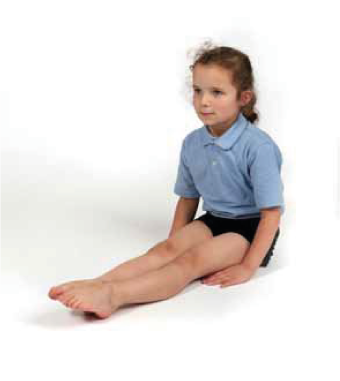
- Practitioner or another child issues a command requiring a specific response, e.g. ‘sit on floor, with legs together straight out in front of you with ankles and toes stretched’
- Child responds immediately by performing the required action/activity
- Practitioner gives further instructions to refine/amend/adapt action/activity
- Child responds immediately by refining, amending or adapting their actions as required
- Child can describe these actions accurately to a practitioner
Safety
Ensure…
- floor is clean and free from debris
- each child has their own space to work in
Opportunity to develop
- Control
- Co-ordination
- Flexibility
Physical Development Area of Learning
- contributes to ‘Personal’ and ‘Adventurous and physical play’ skills sections
If you see
| Observation | Likely Cause | Solution |
|---|---|---|
| Uses wrong body part | Unsure where this body part is, or has not heard accurately | Reinforce words with images to confirm which body part should be used |
| Action is rushed, or in wrong order or actions are missed out | Insufficient co-ordination to execute actions in the correct sequence | Slow actions down, repeat verbal cues and use images and pictures to reinforce order |
| Actions occur in the wrong space/place | Unsure where the place/space is, or has not heard correctly | Practitioner to physically place child in the correct place, provide lots of demonstrations performed close to the child |
| Wrong quality, e.g. stamps instead of creeps | Unsure of what the quality is, lacks control to apply appropriate quality or has not heard correctly | Use nursery rhymes/stories or imagery to help child understand the concept of quality required. Use music to reinforce quality required |
Can you see?
- the child using the correct body part?
- the child performing the required action?
- the child performing the action at the correct time?
- the child performing the action in the right place?
- the child performing the action with the correct quality?
-
Mostly No
- Reinforce name of body part
- Use nursery rhymes, action songs and raps to introduce body parts
- Use toys to reinforce body part / action
- Practitioner helps child by demonstrating required action close to the child
- Practitioner physically places child in correct place/position
- Use stories and imagery to help children develop a concept of quality
-
Yes and No
- Use nursery rhymes and action songs
- Add movement to music/songs
- Practitioner reinforces and uses language at every opportunity, e.g. when dressing and undressing, ‘put your arms above your head, with your arms by your ears’
- Use positional language with toys and games/drawings, etc.
-
Mostly Yes
- More complex / faster nursery rhymes and action songs
- Play ‘Simon says’ type games
- Children decide which body part, actions, when and how
- Children verbally describe actions for other children to perform
- Draw pictures of actions
-
Challenge
- Stand feet together in the middle of the bubble – imagine you are standing in the middle of a clock face, keep one foot still and lunge with the other foot to the outer edge of bubble and then back to middle, right foot to 12, 1, 2, 3, 4, 5, 6, left foot to 6, 7, 8, 9, 1O, 11, 12, then in response to a range of cues – feet matrix.
- Stand feet together in the middle of the bubble, hold racket or scarf etc. with hands shoulder-width apart, reach above head, reach forwards and down, twist to side, repeat on other side, hold arms above head and stretch over to the right then left – trunk matrix.
- Stand feet shoulder-width apart, lift both arms straight up above head, move both arms down, one up and one down, then opposite one up, etc. Stand feet shoulder-width apart, lift both arms out in front at shoulder height, lift both behind as high as possible, lift one in front and one behind, then opposite one in front, etc. Stand feet shoulder width apart lift both arms out to the side at shoulder height – arm matrix.
- Combine feet, trunk and arm matrix actions, then in response to a range of cues.