


Instructions
Definition of activities: breathing is a crucial area of swimming, so learning to breathe out in the water will help a child feel at ease. These activities will encourage children to take a breath in before their face makes contact with the water. They will also learn to trickle their breath out in the water with control.
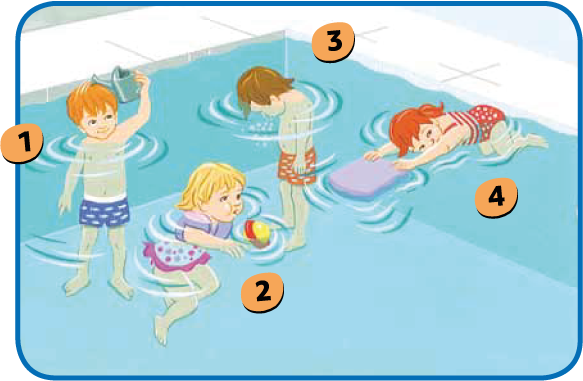
- Wash face and pour water over head
- Blow egg flips with chin on the water
- Trickle the breath out into the water, lift chin up and breathe out
- Push and glide in a streamlined position, taking one breath
Safety
Ensure…
- before the activity begins, the children are listening carefully to instructions and responding appropriately
- children are moving in their own space or working in pairs, copying one another
- children enter the water in the shallow end, feet first
- arms are extended with hands clasped together for underwater push and glide activities
Opportunity to develop
- Sensory awareness
- Physical control
- Co-ordination
Physical Development Area of Learning
- contributes to ‘Adventurous and Physical Play’ skills section
If you see
| Observation | Likely Cause | Solution |
|---|---|---|
| Child doesn’t like putting their face in the water | Lack of confidence and fear of taking in water through the nose | Wash face and use a watering can to trickle water over the head |
| Unable to exhale while face is in the water | Lacks the ability to control breathing out | Place water in cupped hands and blow ripples. Blow egg flips. |
| Unable to link a push and glide movement with breath control | Fear of water in the mouth and nose | Stand, take breath and blow out for a count of 3. Take a breath first, place face in water, then push and glide. |
Can you see?
- the child blowing bubbles?
- the child relaxed and displaying breath control?
- the child blowing out underwater and breathing in when the mouth is out of the water?
- the child turning their head to the side and breathing in?
- the child performing pushing and gliding activities with their face in the water?
-
Mostly No
- Wash arms, legs and body while sitting on the side
- Hold water in cupped hands, then bring it close to the face and blow water to make ripples
- Stand up in the water and blow out to make different noises
- Stand up in the water and hum loudly
- With chin on the water, blow egg flips so that the colour changes
- With face in the water, hum or blow out
- Blow gently into the water, making noises
-
Yes and No
- Move floats around using different parts of the face.
- Encourage deeper submersion through action songs such as “Ring o’ Roses” and “Half a Pound of Tuppenny Rice”.
- Push and glide with two floats or one float, then blow bubbles.
- Breathe in with arms extended in front of head, then stand face down to push and glide: blow bubbles.
- In shallow water, pick up sinkers from the pool floor (entering feet first): take a breath, jump up and sink down gently. Then open eyes, breathe out, pick up the sinker and rise to the surface.
- Play “Treasure Hunt”, spacing out the equipment. Reinforce the rules: sink feet first and collect one item each.
-
Mostly Yes
- Challenge a group of children: “Can anyone sit on the floor gently for 3 seconds?”
- Stand with face in the water and blow bubbles. Turn head to the side and take a breath, then return face to the water and blow out.
- Hold the rail with legs extended at the surface. Place the face in the water and turn head to breathe in with cheek resting on the surface. Return head to centre and blow out.
- Use partner work, with children taking turns to hold a large hoop. Place the hoop partly under the water, so children push and glide through the hoop with arms extended and hands together. Lower the hoop as required.
- Push and glide with arms extended, then take one breath to the front and return face to the water.
- Push and glide with arms extended, then take one breath to the side and return face to the water.
- Copy a partner’s breathing activity with feet placed off the floor.