


Instructions
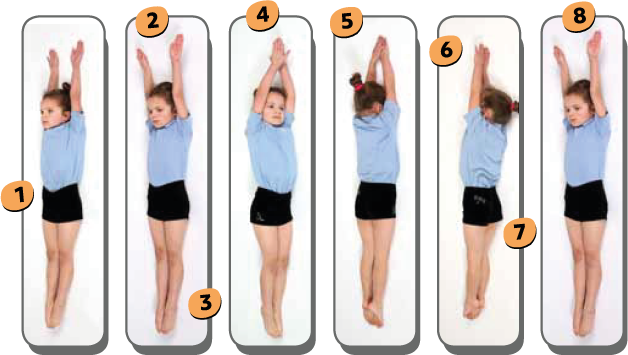
A log roll is a full rotation of the body from head to foot. The roll involves a straight body lying on the floor with legs fully stretched and arms extended above the head. It is important in trampolining, diving and gymnastics.
- Lie on the back with body straight
- Raise the arms straight above the head and slightly off the ground
- The legs are straight and together with the ankles and toes stretched
- Rock sideways to initiate the roll
- Roll sideways from back to tummy and over onto the back again
- Keep the body and arms in a straight line all the way through the roll
- Either the tummy or lower back maintains contact with the floor throughout the roll
- Roll in a straight line
Safety
Ensure…
- children do not get too dizzy rolling
- children do not roll when others are on the mat
- children always roll on floor mats
- mats are placed safely and appropriately in the room
Opportunity to develop
- Co-ordination
- Control
- Spatial awareness
- Body awareness
- Body tension
Physical Development Area of Learning
- contributes to ‘Personal’ and ‘Adventurous and physical play’ skills sections
If you see
| Observation | Likely Cause | Solution |
|---|---|---|
| Poor roll with little movement | Legs and arms are in contact with the floor | Assist the child with their roll, or perform down a slight incline |
| Child’s body does not maintain a straight body position | Push with the arms and legs to initiate the roll | Practise movements to develop extension, stretching and tension of the body |
| Unable to rock and roll on their hips | Feet and arms touching floor | Use an incline to achieve momentum |
Can you see?
- the child’s arms straight above the head, slightly off the floor?
- the child’s legs straight and together with the ankles and toes stretched?
- the child rolling from back to tummy and then onto back again?
- the child maintaining an extended body position during the log roll?
- the child’s tummy or lower back in contact with the floor throughout the roll?
- the child rolling in a straight line?
-
Mostly No
- Lie on the back with arms straight above the head and the legs stretched out. Stretch the feet and legs as much as you can.
- Practise ‘Trap the Mouse’.
- Lie on the back or tummy with the arms and legs extended. Rock back and forth, side-to-side.
- Practitioner holds hands to support children to turn over.
- Child uses hands to assist the rolling action.
- Use an inclined surface to assist the rolling action.
-
Yes and No
- Lie on the back with arms and legs stretched. Lift the feet slightly off the floor, and lift the arms slightly off the floor. Lift both feet and legs at the same time – tense body in straight position.
- Lie on the back with the feet raised off the floor and the arms straight above the head. Move from a straight to saucer shape.
- Lie on the stomach with the legs straight and raised slightly off the floor. Make a ‘Sky Diver‘ shape.
- Lie on the stomach, with feet and arms raised and in ‘Sky Diver’ shape, rocking back and forth.
- Lie on the stomach and go from a straight to arch shape and back to straight.
-
Mostly Yes
- Roll and finish in a saucer or dish shape
- Roll and finish in a ‘Sky Diver’ or arch shape
- Roll combining dish and arch shapes
-
Challenge
- Log roll at different speeds
- Log roll with eyes shut – can you stay in a straight line?
- Log roll under a parachute
- Log roll and try to change speed in the middle of the action
- Log roll along a narrow padded surface
- Log roll in response to a range of cues