


Instructions
Definition of activities: guidelines for practitioner and children to ensure safe practice in and out of the pool.
- Walk to poolside quietly and sit at the wall
- Use the shower before entry
- Listen to safety instructions
- Random organisation
- Exit safely
- Wave organisation
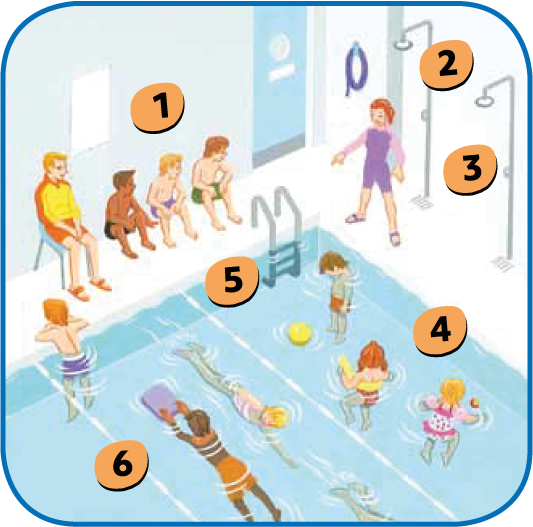
Safety
Ensure…
- the children understand pool safety rules and the dangers outside the water, while maintaining their own safety
- the children listen to instructions from staff
- children do not enter the poolside or the pool until told
- no running on the poolside
- the children sit at the wall after entry to the poolside
- that a whistle is carried by the practitioner for emergency use only
- children are encouraged to swim without goggles to improve survival techniques – children with sore eyes may need the protection of goggles
Opportunity to develop
- Awareness of safety issues in the pool and the open environment
Physical Development Area of Learning
- Safety
If you see
| Observation | Likely Cause | Solution |
|---|---|---|
| Child is nervous in the changing area | New experience | Let them observe the first session. Fit support aids before entry. Use a “buddy system” in the water. |
| Boisterous behaviour | Excited and overconfident, leading to poor balance | Maintain close control and reinforce safety instructions. Use support aids as a precaution if necessary. |
| Poor listening skills | Unable to hear in the pool environment or lack of concentration | Question the child’s understanding of pool safety |
| Child enters the water before being told | Pushed in or eager to start | Ask them to get out and reinforce safety instructions |
Can you see?
- the child recognising the need for good behaviour in the changing room and pool?
- the child understanding and respecting the dangers of water?
- the child behaving appropriately on the poolside?
- the child entering the water safely?
- the child answering questions on pool and water safety?
-
Mostly No
Guidance for practitioner
- Visit the pool to complete a risk assessment or discuss the pool with an experienced colleague.
- Get to know the pool’s normal operating procedures (NOP) and emergency action plan (EAP).
- Alert the pool staff if any child has a medical condition.
- Check the practitioner to pupil ratio – do you have one practitioner to 20 improver swimmers or one to 12 non-swimmers?
- Dress suitably when teaching children to swim. Tell children how to dress appropriately for swimming, encouraging the use of hats.
- Sign the register when entering the pool, confirming the number of children and practitioners.
- Test each child’s ability level in the shallow end and use safe organisation in the water.
- Count the children in and out of the pool.
-
Yes and No
Guidance for children
- When changing for swimming, remove jewellery, tie hair back and use toilet and shower facilities
- Stand in an orderly line before entering the poolside
- When the practitioner gives permission, walk onto the poolside and sit quietly at the wall
- Listen carefully to the safety talk
- Avoid pushing
- Fit support aids before entry if needed
- When the practitioner gives permission, enter the pool safely, walking down the steps with your back to the water
- Keep close to the edge
- Stay in your area of the pool
- Avoid ducking under the water
-
Mostly Yes
- Before swimming on your back, look behind to see the way is clear. Use a guide on the roof or count your strokes to avoid collision with the pool wall.
- Know the Water Safety Code: SPOT THE DANGERS – TAKE SAFETY ADVICE – GO WITH A FRIEND – LEARN HOW TO HELP.
- Leave the pool via the steps or sides and tidy up equipment after the session.
- Answer questions on pool and open water safety.
- Walk to the changing rooms when told.
In An Emergency
- Respond quickly to the emergency alarm, whistle or fire bell. Get out of the water at the nearest end and sit quietly at the wall.
- Exit over the side if possible, otherwise use the steps.
- On evacuation, leave equipment in the pool.