


Instructions
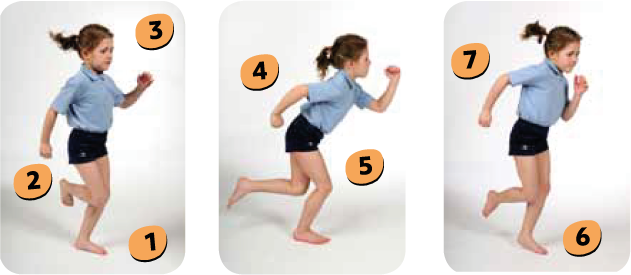
Running is similar to walking extremely fast except at times both feet are off the ground. The arms drive forwards and backwards in opposition to the legs. Together with athletics, most major games involve running.
- Run along a narrow path
- Lift knees high with heels close to bottom
- Keep the head up, looking forward
- Arms drive back and forwards with elbows at 90°
- Opposite arm to leg
- Run on the balls of the feet; keep the heels off the floor
- Keep the shoulders and hands relaxed
Safety
Ensure…
- the surface is safe and appropriate children wear appropriate footwear
Opportunity to develop
- Control
- Co-ordination
- Flexibility
Physical Development Area of Learning
- contributes to ‘Personal’ and ‘Adventurous and physical play’ skills section
If you see
| Observation | Likely Cause | Solution |
|---|---|---|
| No arm drive | Arms down by their side; not aware of their arms’ importance to running | Sit on their bottoms and drive as fast as they can with their arms. Move along the floor. |
| Runs flat footed | Heel strikes floor first | Move on balls of feet |
| Looks at ground | Concentrate on action | Head up and focus on a spot in the distance |
| Short ‘choppy’ stride | Knees do not lift high enough which does not allow the heel to get close to the bottom | Use marching songs like ‘The Grand Old Duke of York’ to lift their knees up high. Increase the speed of the music, beat or clap. |
| Loses balance | Knees do not lift high enough which does not allow the heel to get close to the bottom | Walk through the actions emphasising driving opposite arm and knee |
| Falls over when they run and has a very short stride | Leans forwards excessively | Keep head up, look forwards |
Can you see?
- the child running along a narrow path?
- the child running on the balls of their feet?
- the child’s head and trunk in line?
- the child lifting their knees high?
- the child driving their arms backwards and forwards?
- the child lifting their heels up close to their bottom?
- the child displaying a definite flight phase? (both feet off the ground at some stage)
-
Mostly No
- Sit on the floor and drive arms back and forth. Increase speed of arm action. Try to move along the floor and lift bottom off the floor.
- Run on the spot lifting knees high; try to touch hands held out at waist level.
- Whilst standing, reach forward with one leg and opposite arm.
- Run with hand held by practitioner.
-
Yes and No
- Run within narrow paths marked out with chalk, cones, and ropes
- Run a longer distance
- Run and fix eyes on a target; keep head up
- Run for 5 or 10 counts
-
Mostly Yes
- Slalom running around obstacles
- Run in different directions either on command or independently
- Speed up and slow down: on command, independently, to mirror music or a drum beat
- Explore what happens when you use a fast arm / slow leg action or a slow arm / fast leg action
- Follow my leader runs – leader changes speed, direction, or pathway
-
Challenge
- Run in different directions and at different speeds, then in response to a range of cues
- Run from spot to spot, accelerating and decelerating in response to a range of cues
- Run alongside a partner who dictates the pace – slow, sprint, jog, accelerate, decelerate, etc.
- Run over low hurdles