


Instructions
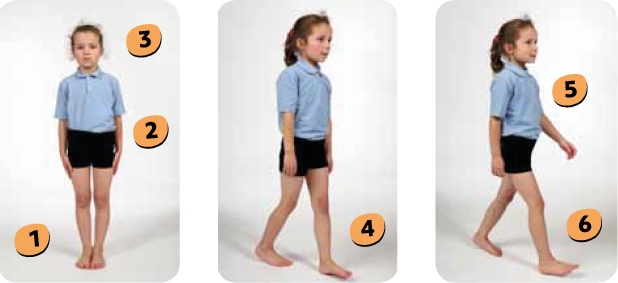
Walking is the most fundamental travelling action and as such forms the basis of many other locomotor actions.
- Stand with feet together, facing forwards
- Stand up straight and ‘Trap the Mouse’
- Keep the head up and eyes focused forwards
- Step forwards with heel leading and moving onto balls of the feet to push off into the next step
- Swing arms in opposition to legs, keeping them relaxed and close to the body
- Movement is continuous – as one foot lands, the other leaves the floor so there is always one foot in contact with the floor
Safety
Ensure…
- the surface is free from sharp objects
- children keep heads up
- the activity is built up gradually
Opportunity to develop
- Co-ordination
- Control
- Spatial awareness
Physical Development Area of Learning
- contributes to ‘Personal’ and ‘Adventurous and physical play’ skills sections
If you see
| Observation | Likely Cause | Solution |
|---|---|---|
| Falls forward | Action insufficiently co-ordinated | Walk supported by a wheeled toy |
| Sits down | Knees remain bent | Hold hands to assist the action |
| Wobble | Insufficient body strength to co-ordinate action | Practise crawling |
Can you see?
- the child’s feet facing forwards?
- the child’s head up and eyes focused forwards?
- the child’s back straight, performing ‘Trap the Mouse’?
- the child’s heel leading?
- the child pushing off the balls of their feet?
- the child’s arms relaxed and swinging in opposition to legs?
- the child walking in a continuous movement with one foot always in contact with the floor?
-
Mostly No
- Practise crawling on hands and knees
- Practitioner assists by holding child’s hands
- Walk pushing a wheeled toy
- Walk from object to object
-
Yes and No
- Walk along a narrow path
- Walk on apparatus
- Walk as quickly as possible
- Walk over other children laid on the floor
-
Mostly Yes
- Walk backwards and sideways
- Walk up and down an inclined bench
- Walk around an obstacle course
- Walk on uneven ground
- Walk on different surfaces
-
Challenge
- Walk along a line, in different directions and at different speeds, then in response to a range of cues
- Walk along a narrow straight balance beam – forwards, backwards, eyes closed, in response to a range of cues
- Walk along a narrow curving balance beam – forwards, backwards, eyes closed, in response to a range of cues
- Walk performing different actions at the same time, for example lifting knees, raising heels to bottom, lift knee to touch opposite elbow, throwing and catching a ball, etc.
- Walking using combinations from above