


Instructions
Climbing is achieved by alternately gripping with and pulling on arms and pushing with legs. Efficient climbing allows children to explore their surroundings and satisfy their inquisitive nature.
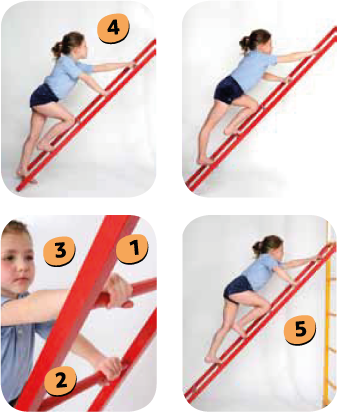
- Reach the right hand up and grip the bar/rung firmly by placing the thumb around the bar/rung.
- Step onto the first rung of the ladder / climbing frame with the right foot.
- Pull on the right hand and push with the left leg.
- Reach the left hand up and grip bar/rung firmly. At the same time step up onto the next bar/rung with the right foot.
- Continue to take one step at a time.
Safety
Ensure…
- children are aware of other children’s hands when climbing
- children climb no higher than their own height
- the number of children climbing at any one time is restricted
Opportunity to develop
- Co-ordination
- Balance
- Motor and manipulative skills
- Spatial awareness
- Upper body strength
- Control
Physical Development Area of Learning
- contributes to ‘Personal’ and ‘Adventurous and physical play’ skills sections
If you see
| Observation | Likely Cause | Solution |
|---|---|---|
| Child wobbles | Uses the same foot and hand | Practise crawling and ‘Crawling Soldiers’ |
| Stops between steps | Lacks confidence, or lack of body strength | Allow children to climb up small objects initially to get confidence and build up strength |
| Hands slip off from the equipment | Fails to wrap their thumbs and hands around the bar/rung | Explore activities that progress the ability to grip and grasp, e.g. holding hands, pulling a partner back and forth, pulling objects |
| Child swings off the climbing apparatus | Improper sequencing of the movements of the arms and legs | Practise marching, simple stepping actions (‘Foxes’) and crawling activities (‘Crawling Soldiers’) on the mat, encouraging legs and arms to work in opposition |
Can you see?
- the child demonstrating a strong hand grip?
- the child climbing up/onto apparatus and down again?
- the child alternating foot and hand stepping when climbing?
- the child climbing fluently without long pauses?
- the child showing good balance and body control?
-
Mostly No
- Grip, squeeze and grasp different objects of various textures, widths and sizes.
- Practise ‘Foxes’.
- Crawl between two sets of cones: travelling forwards and backwards, at different speeds, avoiding contact.
- Climb up steps/stairs using feet and hands.
- Stand on two feet, lift the opposite leg (bent at the knee) and arm as if climbing (‘Man the Rigging’ activity). Change the arm and leg. Do this slowly, several times.
- Place hoops on the floor. Children have to place feet and hands into the hoops and climb along the floor.
-
Yes and No
- Move over children lying face down on the floor using a climbing action – no contact
- Climb up onto a bench/steps using feet only
- Use a climbing action to move along a horizontal ladder
- Climb up and down slightly inclined benches/plank
- Climb along a slightly inclined ladder
- Climb up and down a gradually increasing inclined ladder, stepping on each rung
-
Mostly Yes
- Climb up and down vertical ladders
- Climb in different environments, different heights, uneven rungs, etc.
- Climb through the rungs or shapes or holes in equipment
- Climb up across and down a climbing frame
- Swing across a horizontal ladder of a climbing frame
-
Challenge
- Climb in different directions and at different speeds, then in response to a range of cues
- Perform some of the Bouldering Activities from the Outdoor Learning Cards