


Instructions
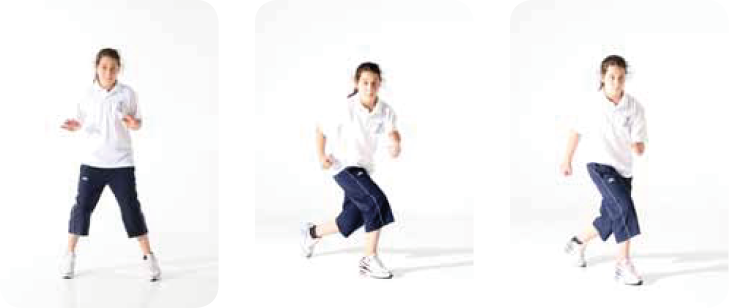
The ‘Crossover Step’ is used to change direction quickly
- Get into the ‘Ready Position’, with weight slightly on balls of feet
- Keeping knees bent and hips low, transfer weight sideways, out over left foot
- Step across and in front onto right foot
- Use arms to balance
- Continue travelling in new direction either by sidestepping or sprinting
Safety
Ensure…
- the area is free from objects
- the surface is not slippery
Opportunity to develop
- Control
- Agility
- Motor Skills
- Accuracy
If you see
| Observation | Likely Cause | Solution |
|---|---|---|
| Child stumbling | Weak core stability | Encourage strong stance |
| Off balance | Standing too upright, not bending knees and sinking hips, not shifting weight | Slow it down and really emphasise each point |
Can you see?
- the child getting into the ‘Ready Position’?
- the child moving on the balls of their feet?
- the child keeping their hips low?
- the child stepping across and in front?
- the child’s head stable and their eyes focused in front?
-
Mostly No
- Walk the step through
- Stand behind a partner and copy their actions
- Put hands on hips to feel transfer of weight
-
Yes and No
- ‘Crossover Step’ into sidestep
- ‘Crossover Step’ into jog
- ‘Crossover Step’ at a marker
-
Mostly Yes
- ‘Crossover Step’ through a cone slalom
- ‘Crossover Step’ to travel in different directions, pathways and speeds
- ‘Crossover Step’ into ‘Grapevine Step’
-
Challenge
- ‘Crossover Step’ to travel in different directions and at different speeds, then in response to a range of cues
- Use ‘Crossover Step’ to complete a figure of 8, W, M, square, slalom pathway in the quickest possible time
- Combine ‘Crossover Step’, ‘Side-step’, ‘Leaping’, ‘Galloping’ and ‘Skipping’ in response to a range of cues, using different directions, pathways and speeds