


I am a Teacher
These resources are used by teachers to give young people the skills and confidence, from an early age, to be physically literate through high-quality, engaging sporting experiences.
Why should you use these resources?
The resources on this platform, whilst created for earlier curricula, can be utilised to provide ideas for practitioners in a range of settings and activities.
These resources are still relevant, for anyone involved in offering physical activity opportunities for individuals, because they are based on the principles of child development.
We are giving you access to the resources here so that you can create and design exciting developmental learning opportunities within the curriculum, in extra-curricular and within community provision.
These resources are a springboard for your ideas that you can adapt to meet the needs and interests of your learners.
The resources are not:
- Professional learning
- Schemes of Work
- A series of sessions
- Prescriptive sessions
- Lesson plans to pick up and deliver in a particular order.
Pedagogy, teaching or coaching approaches are not the focus of the resources at this point, however, the resources will:
- Complement and support you in building and designing your curriculum /activity offer
- Provide a bank of ideas and appropriate skills and activities for you and your learners
- Enable you to choose, use and apply them within your sessions
Warning:
The expectation is that you will have undertaken previous training and learning around health and safety and pedagogical / teaching / coaching approaches.
The platform will be further developed in the future and resources added as they become available.
What is a child-centred approach?
A child-centred approach enables children and young people to take control of their own learning.
Sessions/lessons are organised around the child and their personal needs and interests.
Teachers and coaches are there to provide support and facilitate the child’s learning, but children determine the direction of their own learning following their natural curiosities, interests and passions.
How to use the resources
In keeping with the child/learner-centred approach, there is no set way to use the resources.
However, there are a number of approaches and considerations that you could use to develop your session.
How to Navigate
- Pick and Mix
Click on pick and mix to select from the following:
Creative Movement – These resources have been designed to support thematic and holistic learning, set within the context of creative movement, dance, creative games making and creative activities for learners at the beginning of their journey.
Dance – These resources have been designed to support thematic and holistic learning, set within the context of dance and expressive movement throughout a learners’ journey.
Dragon Multi Skills – These resources offer learners opportunities to incrementally apply their skills in a range of collaborative and competitive activities. These will form the basis of most games, activities, and sports they should be involved in every day and will play in later life.
Dragon Sport – These resources offer learners opportunities to further develop communication, collaboration, and leadership skills in a range of collaborative and competitive activities Experiencing success and enjoyment further develops confidence and motivation for a lifetime enjoyment in sport
Gymnastics – These resources are designed to introduce body schooling activities, foundation shapes and foundation positions to support gymnastic activities. These activities are vital from a physical development perspective and should be used to develop strength and conditioning, stamina, and flexibility.
Outdoor Learning -These resources offer opportunities for learners to be engaged in exciting and adventurous activities in which they can manage risk, use physical skills to overcome challenges and to problem solve. Activities encourage learners to respect and appreciate their environment.
Play to Learn – introduces activities which correspond with the key milestones of child development including the social stages of ‘ I can work by myself’, ‘ I can work alongside others’ and ‘ I can work with others’. Using story books and activities learners will be introduced to a range of skills and concepts. Fun and play develops confidence, motivation, and physical competence recognising the importance of starting learners on the physical journey at an early age.
*You will notice that on some resources there is a splash icon – this highlights where the skills and activities could be undertaken within an aquatic environment.
2. Resource Type
If you click on Resource Type you will be able to select from the following options:
Skill – these items are all descriptions of discrete skills / techniques that a learner can practise to become more proficient. Learners feel a sense of achievement as they master these skills. These skills can be considered as a physical version of phonics with the mastery of some being fundamental to the acquisition of others. Skills practise should be included as part of a leaners daily physical activity. For example, skipping, crawling soldier, under arm throw etc.
Activity – these items are all engaging learning activities that provide learners with the opportunity to apply their skills in a range of contexts whilst exploring STEP spaces, tasks, equipment and people. Activities should form part of the learners daily physical activity. For example, Crazy Capers, Tag Team Tennis.,
Resource – these items hold information that can be used to underpin and support the planning, delivery and evaluation of your learning opportunities. For example, Progression Map, Theme Maps, Motif Development, Everybody Everywhere.
How does it look in reality?
The film shows many examples of a child-centred approach.
Watch the video and look for examples of child-centred approaches. To see child-centered learning in action, see the section of the film from 06:02 in our film. Use the checklist (below) to help you with your observations and reflections.
How could you incorporate the suggestions into your sessions? How would these approaches work for you?
You are now planning your session
Have you got opportunities for:
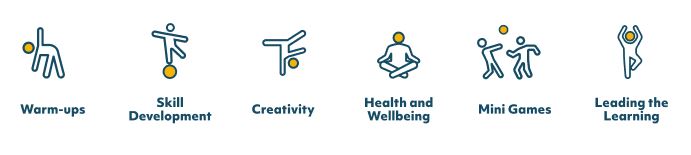
Checklist
Here’s a checklist of things you should consider in your session.
See the checklist here, or download a copy below.
You’re nearly ready to get started
Remember your reflection afterwards. You can use these questions to help you.
What did we do and why?
What went well?
What didn’t go as well?
What have I learned?
What would I do differently next time and why?
Useful Links
Find out more about how education is changing and the new Curriculum for Wales.
Last updated on 31/01/2023